Short answer: this Malta festa calendar 2026 guide starts with the season itself. The Maltese festa season runs mainly from May to September, with the busiest weekends in July and August and the biggest single day on 15 August (Santa Marija), when nine localities celebrate at once. A handful of feasts fall outside summer: in what is left of 2026, the listed dates are Gudja’s feast of Our Lady of the Girdle on Sunday 25 October, Ta’ Xbiex on 15 November, several parishes on 8 December and Mtarfa on 13 December. For 2027, parishes have not published dates yet, but most festas return to the same weekend every year, so the month-by-month calendar below tells you when to expect each one.
Plenty of people in Malta treat festa season like a tour: a different village every weekend, a pastizz in one hand, earplugs in the pocket. This guide covers what a festa actually is, which ones are worth crossing the island for, and how to get home when the last bus has long gone.
Last verified: October 2026. 2026 dates come from published festa listings; 2027 entries show the usual weekend, not a confirmed date.
What a Maltese festa is
A festa is the feast of a parish’s patron saint, or of another saint venerated in one of its churches. Because many towns have more than one parish or church, some celebrate two or three festas a year. Birkirkara, Sliema and Valletta have several each.
The religious core is the same everywhere: a week or so of church services, then on the feast day a solemn Mass and, in the evening, a procession with the statue of the saint carried through the decorated streets. Around that core, the village throws a party.
- Band clubs. Each festa is organised with the parish by one or more band clubs (the local philharmonic societies). Their brass bands play marches through the streets on the days before the feast. The marċ il-kbir, the big march, usually happens on the eve or two days before the main day, and it is the loudest, busiest, most joyful part of the week.
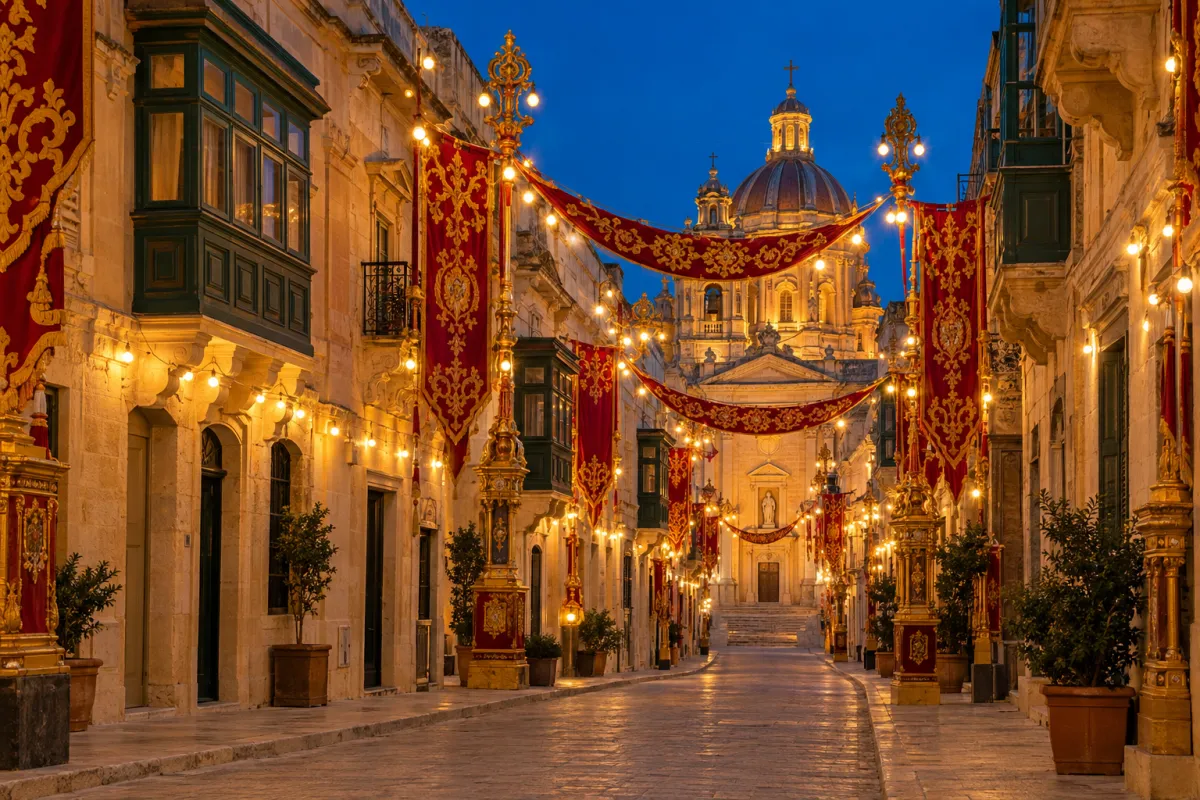
- Decorations. Streets are dressed with banners, damask hangings, festoons of lights and statues on tall wooden pedestals. In towns with two rival clubs, the decorations become a competition.
- Fireworks. Aerial fireworks, ground fireworks with spinning Catherine wheels, and petards that you will hear from early morning. Local fireworks factories, mostly volunteer-run, spend all year building them.
- Food stalls. Nougat (qubbajt), date pastries (imqaret), hot dogs, burgers, candy floss and a lot of Cisk and Kinnie.
You do not need to be religious, local or invited to go. Festas are public street events, free to attend, and visitors are welcome as long as they respect the church services and the procession.

How the festa season works
VisitMalta describes the season as running from late May through September, with hardly a summer weekend when some town or village is not celebrating. In practice the calendar starts earlier and ends later: there are feasts in every month of the year, but outside summer they are smaller and mostly church-focused.
Three rules explain almost every date:
- Most festas are on a Sunday. The main day is usually a Sunday, with the big march and the fireworks on the Friday and Saturday before. So a “festa weekend” really starts on the Thursday.
- Each parish keeps its slot. A village that celebrated on the third Sunday of June this year will almost always celebrate on the third Sunday of June next year. That is why you can plan 2027 from the 2026 pattern.
- Some saints keep their actual day. Santa Marija (15 August), the Nativity of Our Lady (8 September), Sts Peter and Paul (29 June), St Lawrence in Birgu (10 August) and Christ the Saviour in Lija (6 August) are celebrated on the day itself, whatever weekday it falls on. Several of these are also public holidays.
Dates do move. In 2026, published listings show Tarxien’s Annunciation feast moved from 31 May to 7 June, and Munxar in Gozo postponed its May feast to 13 September. So use this calendar to plan the month, then check the parish or band club’s Facebook page about two weeks before.
Malta festa calendar 2026: festas still to come
The summer season is over, but the Malta festa calendar 2026 still has a few dates left. These feasts are still listed for the rest of the year. They are calmer than August festas: expect church celebrations, a procession and in some cases fireworks, rather than a week-long street party.
| Listed date | Locality | Feast | What to expect | Getting there |
|---|---|---|---|---|
| Sun 25 Oct 2026 | Gudja | Our Lady of the Girdle (taċ-Ċintura) | Often called the last festa of the season; Gudja is known for its aerial fireworks for this feast | Buses towards Gudja and the airport area; roads around the parish church close in the evening |
| Sun 15 Nov 2026 | Ta’ Xbiex | St John of the Cross | Small parish feast, church-focused | Walkable from Gżira and Msida |
| Tue 8 Dec 2026 | Bormla (Cospicua), Ibraġ, Ħamrun, Mqabba | Immaculate Conception (public holiday) | Bormla’s is the big one, with a procession through the city | Bus to Cospicua; holiday timetable |
| Sun 13 Dec 2026 | Mtarfa; Gudja; St Paul’s Bay | St Lucy (Mtarfa); Our Lady of Loreto (Gudja); Our Lady of the Expectation (St Paul’s Bay) | Winter parish feasts | Local buses; Republic Day public holiday falls on the same Sunday |
For the bigger events between now and spring, from the Rolex Middle Sea Race to Carnival, see our month-by-month Malta events calendar, and for next month specifically the events in Malta in November guide.
Malta festa calendar month by month (usual pattern for 2027)
This table is built from the 2026 listings and the long-standing pattern of each parish. It shows when each feast usually falls, not a confirmed 2027 date. Where a saint is celebrated on a fixed date, I give the 2027 weekday. Last checked October 2026.
| Month | Locality | Feast | Usual timing |
|---|---|---|---|
| January | Mdina; Iklin | Conversion of St Paul; Holy Family | Second half of January |
| February | Valletta; St Paul’s Bay | St Paul’s Shipwreck; St Paul | 10 February (Wed in 2027, public holiday) |
| March | Sliema; Rabat (Malta) | Jesus of Nazareth; St Joseph | Early March; 19 March (public holiday) |
| April | Floriana; Pembroke | St Publius; Christ Risen | After Easter |
| May | Birkirkara; Swatar; Gudja; Marsa | St Joseph the Worker, Holy Cross, St Anthony; St George Preca; Annunciation; Holy Trinity | 1 May (public holiday) and May weekends |
| June, 1st–2nd Sundays | Għaxaq; Tarxien; Għasri (Gozo); Ħaż-Żebbuġ; Fontana (Gozo) | St Joseph; Annunciation; Corpus Christi; St Philip of Agira; Sacred Heart | Early to mid June |
| June, 3rd–4th Sundays | Mqabba; Żejtun; Xewkija (Gozo); Qrendi; Qormi; Siġġiewi | Our Lady of the Lily; St Catherine; St John the Baptist; Our Lady of Lourdes; St George; St Nicholas | Mid to late June |
| 29 June | Mdina; Nadur (Gozo); Buskett | Sts Peter and Paul, l-Imnarja | 29 June (Tue in 2027, public holiday) |
| July, 1st Sunday | Ħamrun; Luqa; Rabat; Sliema; Għarb (Gozo); Fleur-de-Lys | Immaculate Conception; St Andrew; St Paul; Sacred Heart; Visitation; Our Lady of Carmel | Early July |
| July, 2nd Sunday | Balzan; Kirkop; Fgura; Gżira; Kerċem (Gozo) | Annunciation; St Joseph; Our Lady of Carmel; Our Lady of Succour | Mid July |
| 16 July | Valletta | Our Lady of Carmel | 16 July (Fri in 2027) |
| July, 3rd Sunday | Qormi; Mosta; Victoria (Gozo); Kalkara; Msida; Tarxien | St Sebastian; Holy Family; St George; St Joseph; Our Lady of the Doctrine | Third weekend of July |
| July, last Sunday | Żurrieq; Balluta (St Julian’s); Paola; Santa Venera; St Paul’s Bay; Marsaskala; Sannat (Gozo) | Our Lady of Carmel; Christ the King; St Venera; Our Lady of Sorrows; St Anne; St Margaret | Last weekend of July |
| August, 1st Sunday | Birżebbuġa; Marsaxlokk; San Ġwann; Qala (Gozo) | St Peter in Chains; Our Lady of Pompeii; Our Lady of Lourdes; St Joseph | Early August |
| 6 and 10 August | Lija; Birgu | Christ the Saviour; St Lawrence | Fri 6 and Tue 10 August 2027 |
| Weekend before Santa Marija | Ħamrun; Buġibba; San Lawrenz (Gozo) | St Cajetan (San Gejtanu); St Maximilian Kolbe; St Lawrence | Second weekend of August |
| 15 August | Mqabba, Qrendi, Mosta, Gudja, Attard, Għaxaq, Birkirkara, Ħal Muxi (Żebbuġ), Victoria (Gozo) | Santa Marija (Assumption) | Sun 15 August 2027 (public holiday) |
| August, after Santa Marija | Dingli; Mġarr; Santa Luċija; Sliema (Stella Maris); Żebbuġ (Gozo) | Santa Marija; St Pius X; Stella Maris | Weekend after 15 August |
| August, last Sunday | St Julian’s; Għargħur; Safi; Manikata; Għajnsielem (Gozo) | St Julian; St Bartholomew; Conversion of St Paul; St Joseph; Our Lady of Loreto | Last weekend of August |
| September, 1st Sunday | Żurrieq; Qawra; Sliema | St Catherine; St Francis of Assisi; St Gregory | Early September |
| 8 September | Naxxar; Mellieħa; Senglea; Xagħra (Gozo) | Nativity of Our Lady (Victory Day) | Wed 8 September 2027 (public holiday) |
| September, mid to late | Żabbar; Valletta; Kirkop; Mellieħa | Our Lady of Graces; St Augustine; St Leonard; Our Lady of Mellieħa | Second to fourth weekend of September |
| October | Gudja; Mellieħa; Sliema; Marsa; Valletta | Our Lady of the Rosary; Our Lady of the Girdle; St Francis | October Sundays; Gudja usually the last Sunday |
| November–December | Ta’ Xbiex; Bormla; Mtarfa | St John of the Cross; Immaculate Conception; St Lucy | Mid November; 8 and 13 December |
The big festas worth crossing the island for
Every festa has its loyal crowd, but a few draw people from all over Malta and Gozo. If you only go to three or four in a summer, these are the ones friends will talk you into.
Santa Marija week (around 15 August)
The peak of the season. Nine localities celebrate the Assumption on the same day, and the whole week before is a run of marches and fireworks. Mqabba and Qrendi, neighbours in the south, are famous for their fireworks rivalry, and the ground fireworks there can go on late into the night. Mosta celebrates under its enormous Rotunda dome, and Victoria in Gozo has the island’s biggest August festa. The catch: 15 August is also peak tourist season, peak heat and the week when half of Malta is on leave. Buses are packed, parking does not exist, and you need a plan for getting home.
San Gejtanu in Ħamrun (second weekend of August)
Ħamrun’s St Cajetan festa is known for its huge, boisterous band march, which pulls a young crowd and turns the main road into a moving party. It is one of the most energetic marches of the summer, and one of the easiest to reach because Ħamrun sits on the main bus corridor into Valletta.
L-Imnarja (28–29 June)
Not a typical village festa but one of Malta’s oldest folk feasts, linked to Sts Peter and Paul. It centres on Buskett Gardens near Rabat, with folk singing and traditional food the night before, and the feast day on 29 June is a public holiday. Mdina and Nadur in Gozo celebrate Sts Peter and Paul as their festa on the same day.
The 8 September festas
Victory Day is a public holiday and the feast of the Nativity of Our Lady, celebrated in Naxxar, Mellieħa, Senglea and Xagħra in Gozo. Senglea’s waterfront setting on the Grand Harbour makes it a beautiful one to see, and you can combine it with a walk around the Three Cities. In 2027 it falls on a Wednesday, so expect the festivities to spread across the weekend before.
St Lawrence in Birgu (10 August)
Birgu’s feast is held on the saint’s day and fills the old streets of the city with decorations. Because Birgu is compact and walkable, it is one of the nicest festas to wander slowly, ideally with dinner on the Vittoriosa waterfront before the procession.

Gozo festas
Gozo has its own festa calendar, and many people say it feels more traditional: smaller crowds, more locals, and a church square that becomes everyone’s living room for the night. The main ones by usual timing:
- June: Corpus Christi in Għasri, the Sacred Heart in Fontana, St John the Baptist in Xewkija (under its massive rotunda), and Sts Peter and Paul in Nadur on 29 June.
- July: the Visitation in Għarb, Our Lady of Succour in Kerċem, St George in Victoria (the third weekend), and St Margaret in Sannat.
- August: St Joseph in Qala, St Lawrence in San Lawrenz, Santa Marija in Victoria (15 August), the Assumption in Żebbuġ, and Our Lady of Loreto in Għajnsielem at the end of the month.
- September: the Nativity of Our Lady in Xagħra on 8 September.
The practical issue with Gozo is the crossing back. The Gozo Channel ferry from Mġarr to Ċirkewwa runs through the night, but less often in the small hours, and the fast ferry to Valletta has a fixed last sailing. If you are going for the fireworks, check the timetable first or book a room and make it a weekend.
Fireworks: what to know before you go
Fireworks are the heart of many festas, and there are three kinds you will meet:
- Aerial fireworks are fired from a site outside the village, usually on the eve and the feast night. You can watch them from anywhere with a view of the sky, which is why people often watch from a rooftop, a field edge or a hill nearby.
- Ground fireworks (with the spinning Catherine wheels and mechanical set pieces) are lit in the village itself, usually late at night, often after the procession. Crowds gather close, but stay behind the barriers: wheels can throw sparks further than you expect.
- Petards are the loud bangs during the day. Expect them from early morning in festa week. If you are staying in a village during its festa, ask about it when you book.
Malta also has a separate national fireworks event, the Malta International Fireworks Festival in the Grand Harbour, which is different from the village shows. Festa fireworks are local, competitive and funded by the community, and the factories are mostly run by volunteers.
A word on safety: fireworks in Malta are traditional but not risk-free. Respect cordons, do not pick up unexploded pieces, keep small children and dogs well back, and take earplugs. Anyone sensitive to noise, including pets at home, will want to know the dates of their own village’s festa in advance.

Festa etiquette and practicalities
Festas are relaxed, but a few habits make the night easier for you and for the village.
- Dress for church if you go inside. Shoulders and knees covered. You can stay in shorts on the street, but carry something light if you want to see the decorated church.
- Stand aside for the procession. When the statue comes out, people go quiet, men remove hats, and the crowd makes way. Clapping is common when the statue leaves and returns to the church.
- Band marches are for joining. Walking behind the band with the locals is part of it. You will be jostled, sprayed with confetti and possibly with beer. Keep your phone and wallet in a front pocket.
- Carry cash. Many food stalls are cash only. A nougat bar, a pastizz and a drink will not cost much, but card machines are not guaranteed.
- Heat and water. August festa evenings are still hot. Drink water between beers, and eat before the march.
- Do not park in the village. Roads around the church and the main square are closed during festa hours. Park at the edge and walk, or come by bus.
Getting there and getting home
Getting home box. This is where most festa nights go wrong. Plan the way back first.
- Buses: regular routes run until late evening, but services are diverted around closed roads and get very full after the fireworks. Check the Malta Public Transport journey planner or the tallinja app for the last departure from the village, not just the route.
- Night buses: limited night routes run on certain nights from hubs like Paceville and Valletta; they do not serve every village. Our night bus guide explains the routes and times.
- Taxis and ride-hailing: Bolt, eCabs and Uber all work in Malta, but prices surge and pick-ups inside a festa zone are near impossible. Walk ten minutes out of the closed streets before booking.
- Share the ride: four people splitting a taxi from Mqabba to Sliema usually beats waiting for an overflowing bus.
If the festa is just the start of the night, our Malta nightlife guide covers where to go next, area by area.
How to plan a festa night with friends
Festas are better in a group. You have someone to hold the spot for the ground fireworks, someone who knows the village, and someone to share the taxi with. A simple plan that works:
- Pick the night, not just the festa. The eve (usually Saturday) has the big march and fireworks; the Sunday has the procession. Choose based on what your group wants.
- Meet before it fills up. Arrive around 19:00 to eat and find a spot. By 21:00 the main streets are packed.
- Agree on a meeting point. Phone signal gets patchy in big crowds. Pick a fixed spot, like the band club door or a specific bar, for regrouping.
- Decide who pays for what. Food at a festa is cheap, so most groups pay their own and split the taxi home.
- Bring someone new. A festa is one of the easiest first plans with people you have just met: it is free, public, busy and there is always something to talk about.
If you have only just moved to Malta, festas are also one of the best ways to see local life up close. Every village has its own personality, and after a few summers you will have favourites.
Where to check festa dates
There is no single official festa calendar. The most reliable sources, in order:
- The parish’s own page or the band club’s Facebook page, which publish the programme a couple of weeks before.
- The local council page for road closures and parking.
- VisitMalta’s events listings for the biggest feasts.
- Published festa lists for the year, which are useful for planning but should be confirmed with the parish.
If you spot a date that has changed, get in touch through the contact page. We refresh this Malta festa calendar 2026 page when the 2027 programmes start appearing in spring.
Malta festa FAQ
When is festa season in Malta?
The main season runs from about May to September, with the busiest weekends in July and August. Smaller feasts take place in every month, and Gudja’s feast of Our Lady of the Girdle at the end of October is often called the last festa of the season.
What is the biggest festa in Malta?
Santa Marija on 15 August is the biggest festa day, because nine localities celebrate it at once: Mqabba, Qrendi, Mosta, Gudja, Attard, Għaxaq, Birkirkara, Ħal Muxi in Żebbuġ, and Victoria in Gozo. It is also a public holiday.
Are the 2027 festa dates confirmed?
Not yet. Parishes usually publish their programmes a few weeks before each feast. Most festas keep the same weekend every year, so the usual-pattern table above is a good planning guide, but confirm with the parish before you travel.
Is a festa free to attend?
Yes. Festas are public street events with no entry fee. You only pay for food, drinks and transport.
What time do festa fireworks start?
Petards can start in the morning. Aerial fireworks are usually after dark on the eve and the feast day, and ground fireworks are often late at night, sometimes after 23:00. Check the village programme for exact times.
Can tourists go to a festa?
Absolutely. Visitors are welcome. Cover your shoulders and knees if you go into the church, make way for the procession, and keep an eye on your belongings in the march crowds.
How do I get home from a festa late at night?
Check the last bus from the village before you go, use night routes where they run, or book a taxi or ride-hailing car a short walk away from the closed streets. Sharing a taxi with friends is usually the easiest option after the fireworks.
Plan it with people
A festa is one of the easiest plans in Malta to say yes to: free, outdoors, loud and full of things to talk about. Pick a village from the calendar, choose the eve or the feast day, and get a few people together for it.
Want to turn this into an actual plan? MeetNow is a free app for meeting people in person: a host posts a plan at a public place, says who pays (host pays, split, pay your own or free) and picks who joins. It is live in Malta now on the web, with the iPhone and Android apps coming to the App Store and Google Play soon: open MeetNow and see this week’s plans in Valletta, Sliema and St Julian’s.
We may mention products we’re connected to: see the disclosure page linked in the site footer.