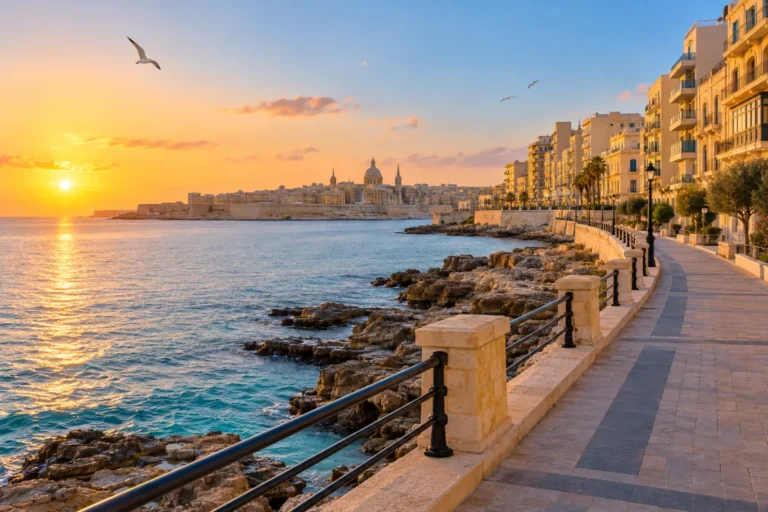
Malta festa season runs mainly from late May or June to September, when almost every weekend one or more towns and villages celebrate their patron saint with a week of brass bands, street decorations, fireworks and, on the final Sunday, a procession with the saint’s statue. A few big feasts fall outside summer (St Paul’s Shipwreck in Valletta on 10 February, for example), but if you want to catch a festa, a summer weekend evening is your best bet. The peak is mid-August, around the feast of Santa Marija on the 15th, a public holiday celebrated in several villages at once.
We are writing this in November, so the 2026 season is over. This guide explains how festa season works, what happens on each day of a typical festa week, what to eat, how to behave, and how to plan a festa night with friends for 2027. For exact dates by village, use our Malta festa calendar.
When is Malta festa season?
Each parish celebrates its patron saint once a year, and most parishes choose a summer weekend, even when the saint’s day is in another month. The result is a season that builds through June, is busy in July, peaks in August and winds down through September.
| Period | What to expect |
|---|---|
| February to May | A few big feasts, including St Paul’s Shipwreck in Valletta (10 February) and St Joseph (19 March). Easter brings processions rather than festas. |
| June | Season starts. Imnarja on 29 June (feast of St Peter and St Paul) brings the traditional gathering at Buskett, and Mdina and Nadur celebrate too. |
| July | Festas most weekends across Malta and Gozo. |
| August | The peak. Santa Marija (15 August) is celebrated in several villages at the same time, and Gozo’s Victoria has its big feast. |
| September | Season closes. 8 September (Our Lady of Victories, a public holiday) is marked in several towns. |
| October to January | Very few festas. Christmas and January baroque concerts take over. |
Many feast days are also public holidays, which means fuller beaches and buses; our Malta public holidays guide lists them.
What happens during a festa week
A festa is not one evening but a whole week, sometimes longer, building to the final Sunday. The exact programme varies by parish, but the pattern is similar.
The build-up (the week or two before)
Decorations go up: damask hangings on the church, rows of statues on pedestals along the main street, garlands of lights, flags and banners. Residents hang the parish flag from balconies. Petards start booming at midday as a countdown.
Weeknights
The church hosts evening religious services, and in the streets, brass bands play marches in the evenings. Some parishes hold smaller fireworks displays and the band club bars stay open late.
Friday and Saturday
The big nights. Bands march through the streets with crowds dancing behind them, and in many parishes Saturday night brings the main aerial fireworks display and, in some places, ground fireworks. The square is packed, food stalls are busy and the atmosphere is part religious feast, part street party.
Sunday
The feast day itself. A solemn Mass in the morning, then in the evening the procession: the statue of the patron saint is carried shoulder-high through the streets, accompanied by the band, clergy and parishioners, with fireworks and confetti along the route. When the statue returns to the church, the crowd cheers and the festa is effectively over.

Fireworks: aerial, ground and petards
Maltese fireworks are handmade by local volunteer fireworks factories attached to the parishes, and villages compete fiercely for the best display. You will hear three kinds:
- Petards (murtali): loud daytime bangs that announce the festa. Mostly noise, little to see.
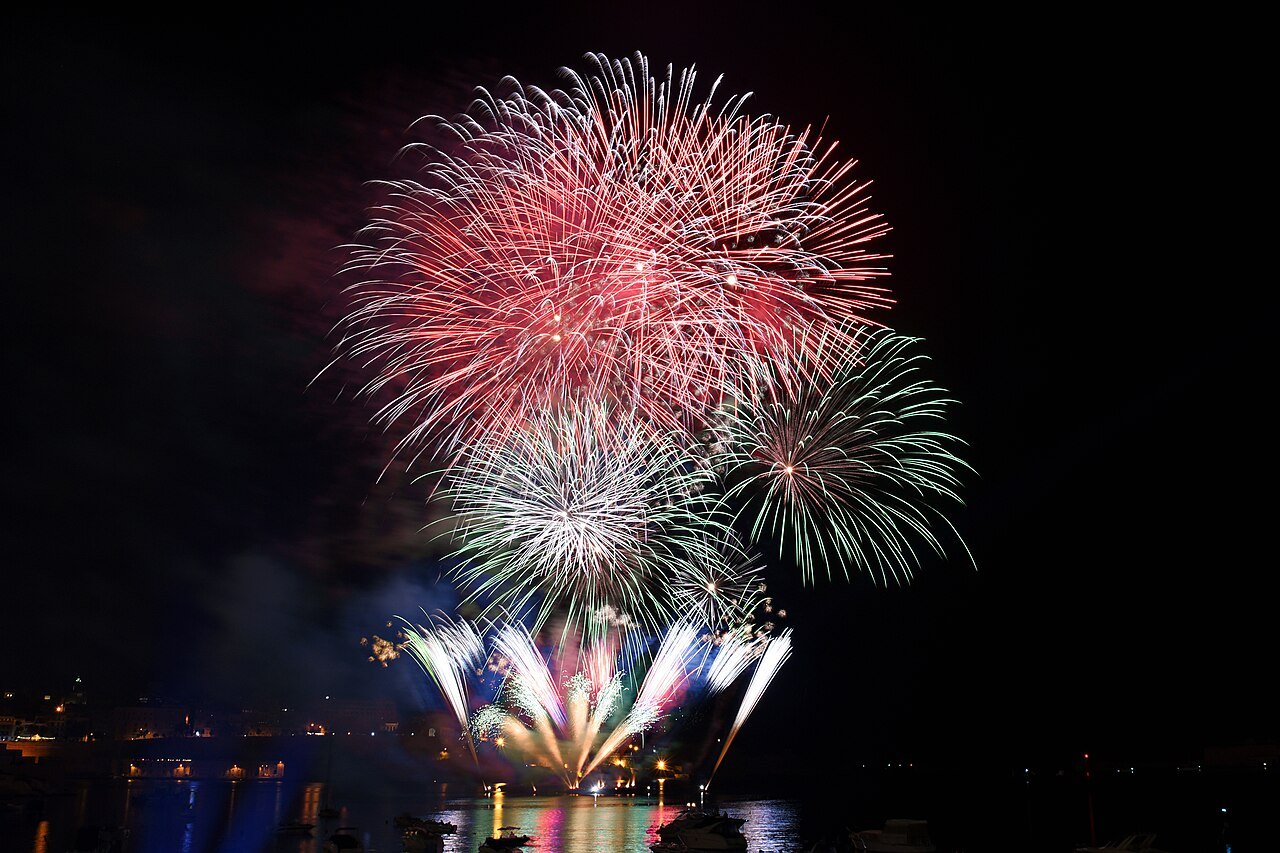
- Aerial fireworks: the colourful night-time shells, often the climax of Saturday or Sunday.
- Ground fireworks (ġigġifogu): spinning wheels and mechanical displays set up on frames, a uniquely Maltese art. If a parish lists ground fireworks, go.
For the separate spring fireworks event in the Grand Harbour, see our Malta fireworks festival guide.
Band clubs, marches and rivalries
Every festa town has at least one band club, and some have two rival clubs, each devoted to a different saint or statue. The rivalry is mostly friendly and very loud: competing marches, competing decorations and competing fireworks. The band club bar is the social heart of the festa, often with drinks at local prices and a terrace over the square. The morning or evening band march, with the band playing upbeat marches and a crowd dancing behind, is the most fun part for many young locals.

Festa food and drink
- Qubbajt (nougat): the festa sweet, sold from stalls in hard and soft versions. Buying a bag is practically compulsory.
- Hot dogs, burgers and kebabs from vans around the square.
- Pastizzi and imqaret (date pastries) from local stalls.
- Cisk and Kinnie, the local beer and bitter-orange soft drink, from the band club bar or a kiosk.
Most stalls take cash, so bring some coins and small notes.
Festa etiquette for visitors
- It is a religious feast. Dress modestly if you go inside the church: shoulders and knees covered.
- Make way for the procession. Step back when the statue passes and do not walk through the line of the procession.
- Do not climb on decorations or the statue pedestals for a photo.
- Be relaxed about the noise. Petards and bands are the point; complaining will not make you friends.
- Do not ask locals which band club is better unless you want a very long answer.
How to plan a festa night
- Pick the night: Saturday for the band marches and fireworks, Sunday evening for the procession.
- Check the programme on the parish or band club’s Facebook page; fireworks times are listed there.
- Arrive early evening to walk the decorated streets before the crowds.
- Agree a meeting point with friends (the church steps or a named bar) because phones struggle in packed squares.
- Plan your way home before the fireworks end. Our night bus Malta guide explains the late routes.
A festa is one of the best group plans in Malta: free, lively and full of things to talk about, which is why it works so well with people you have only just met. It is also a lovely date; see our list of romantic things to do in Malta for more.
The honest downsides
Festas are loud, hot and crowded, and that is part of the charm, but go in with eyes open. Parking near the square is close to impossible, so leave the car further out or take the bus. Roads are closed for the procession, and buses through festa towns are diverted, which can add half an hour to your trip home. Petards start early in the day if you are staying in a festa town, so light sleepers should check the local festa dates before booking a room. And August heat is real even at 10pm: carry water.
Our tip: start with a smaller village festa rather than the biggest one in August. The crowds are calmer, the band club bar is easier to get into and locals are happy to explain what is going on.
Want to turn this into an actual plan? MeetNow is a free web app for meeting people in person, starting in Malta: a host posts a plan at a public place, sets the time and seats, says who pays (host pays, split, pay your own or free) and picks who joins from the people who ask. Open MeetNow and see the plans posted in Malta.
Featured photo: festa fireworks over Malta. Photo: Melvin Degiorgio, Wikimedia Commons, CC BY-SA 4.0.
Frequently asked questions (FAQ)
When is festa season in Malta?
Mainly from June to September, with the peak in August around the feast of Santa Marija on 15 August. A few big feasts happen at other times of year, such as St Paul’s Shipwreck in Valletta on 10 February.
What is a festa in Malta?
A festa is a parish’s annual celebration of its patron saint, lasting about a week, with church services, street decorations, brass band marches, fireworks and a procession with the saint’s statue on the final Sunday.
Which is the best night to go to a festa?
Saturday night is usually best for band marches and fireworks. Sunday evening is the night of the procession with the statue, which is the religious high point.
Are festas free?
Yes. Walking the decorated streets, watching the fireworks and following the procession are all free. You only pay for food and drinks.
Are there festas in Gozo?
Yes. Gozo’s villages celebrate their own festas, mostly in summer, and the August feasts in Victoria are among the biggest of the year.